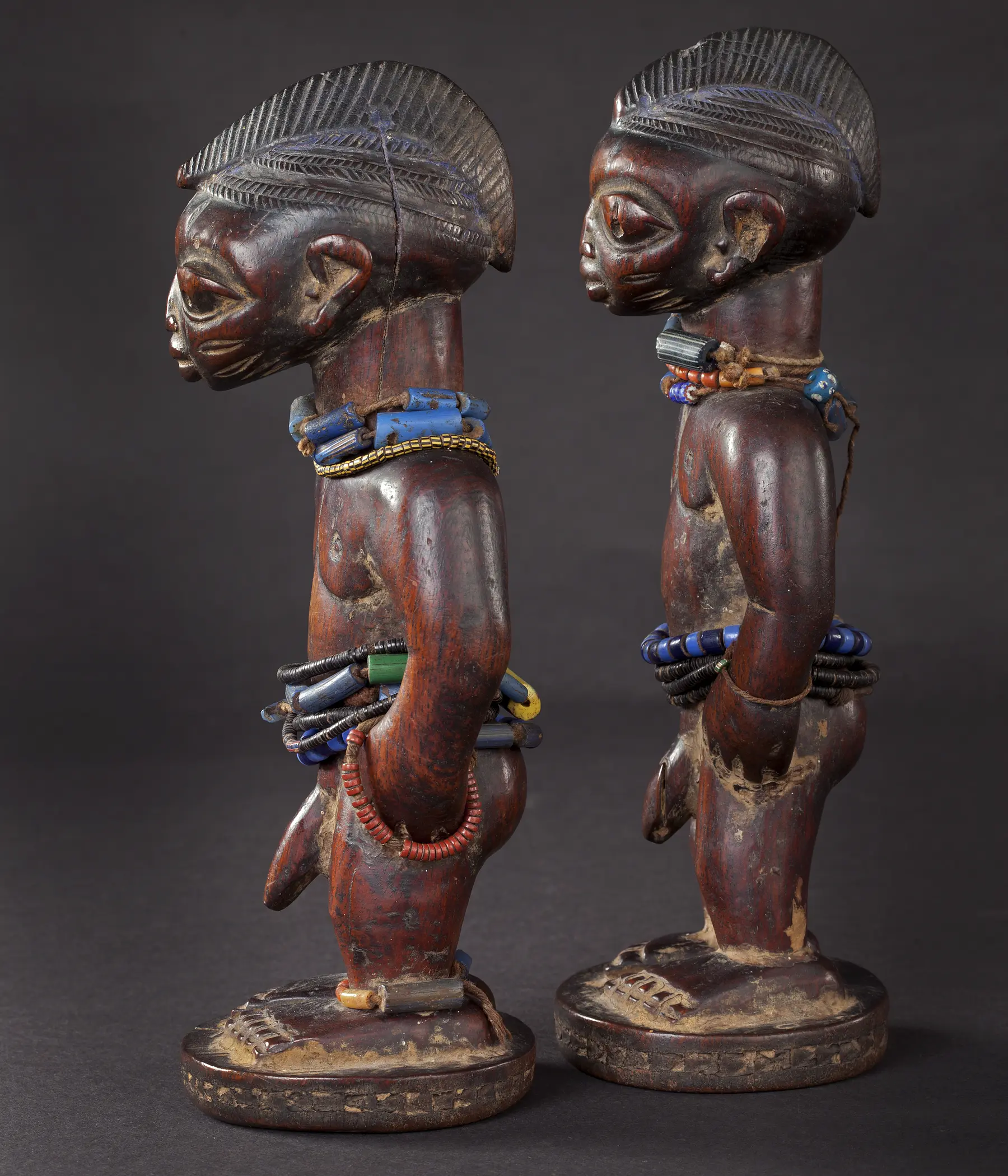
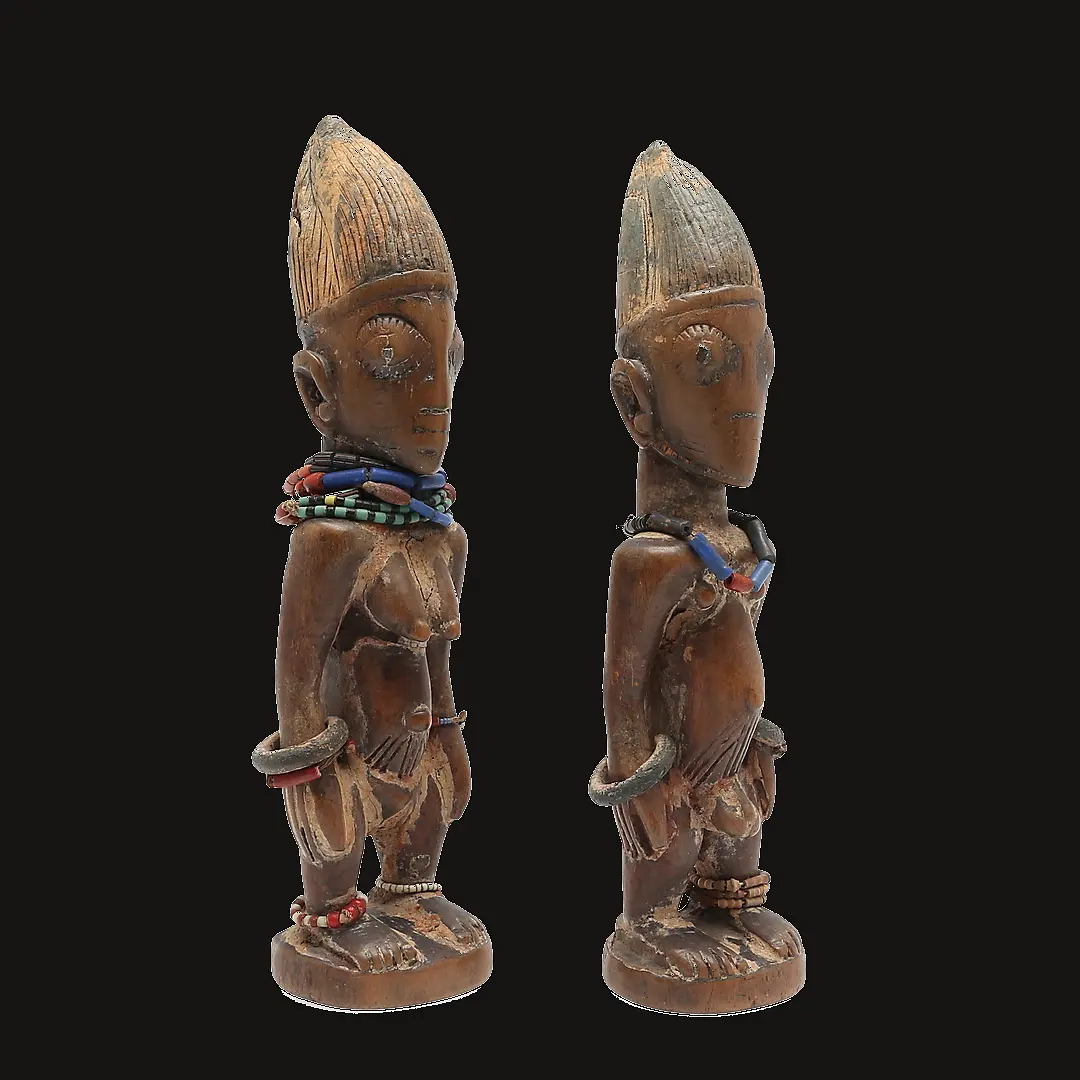
Ritually used pair of Ere Ibeji with beads
Home·Twin tradition

Presence · care · continuity

The Ibeji
Cult

The carving mattered because the relationship continued: through attention, offerings, adornment and memory.

Born two

A twin is never understood alone.

Within Yoruba communities, twinship has long carried an exceptional spiritual and social charge. Twins could be associated with blessing, fertility and prosperity, yet their unusual power also required balance, respect and carefully maintained obligations.

Practice was never identical across Yorubaland. Town, lineage, period, religious change and a diviner's instructions all shaped what a family did. The carved Ere Ibeji belongs to this diverse field rather than to one fixed and universal ritual.

Pair of Ere Ibeji preserving repairs and ritual ornaments

After the death of a twin

A material focus for a continuing bond

Following the death of one twin—or sometimes both—a family might consult an Ifa specialist and commission one or two wooden figures. The sculpture was not intended as a portrait of an infant. It commonly presents an idealized, complete person with adult sexual attributes, upright bearing and an enlarged head.

Once prepared and accepted into the household, the figure could be carried, greeted, washed and cared for. Responsibility often centred on the mother, but could later pass to the surviving twin or another relative.

The work left the carver's hands finished as sculpture, but its biography had only begun.
A surface made by life

Care leaves evidence

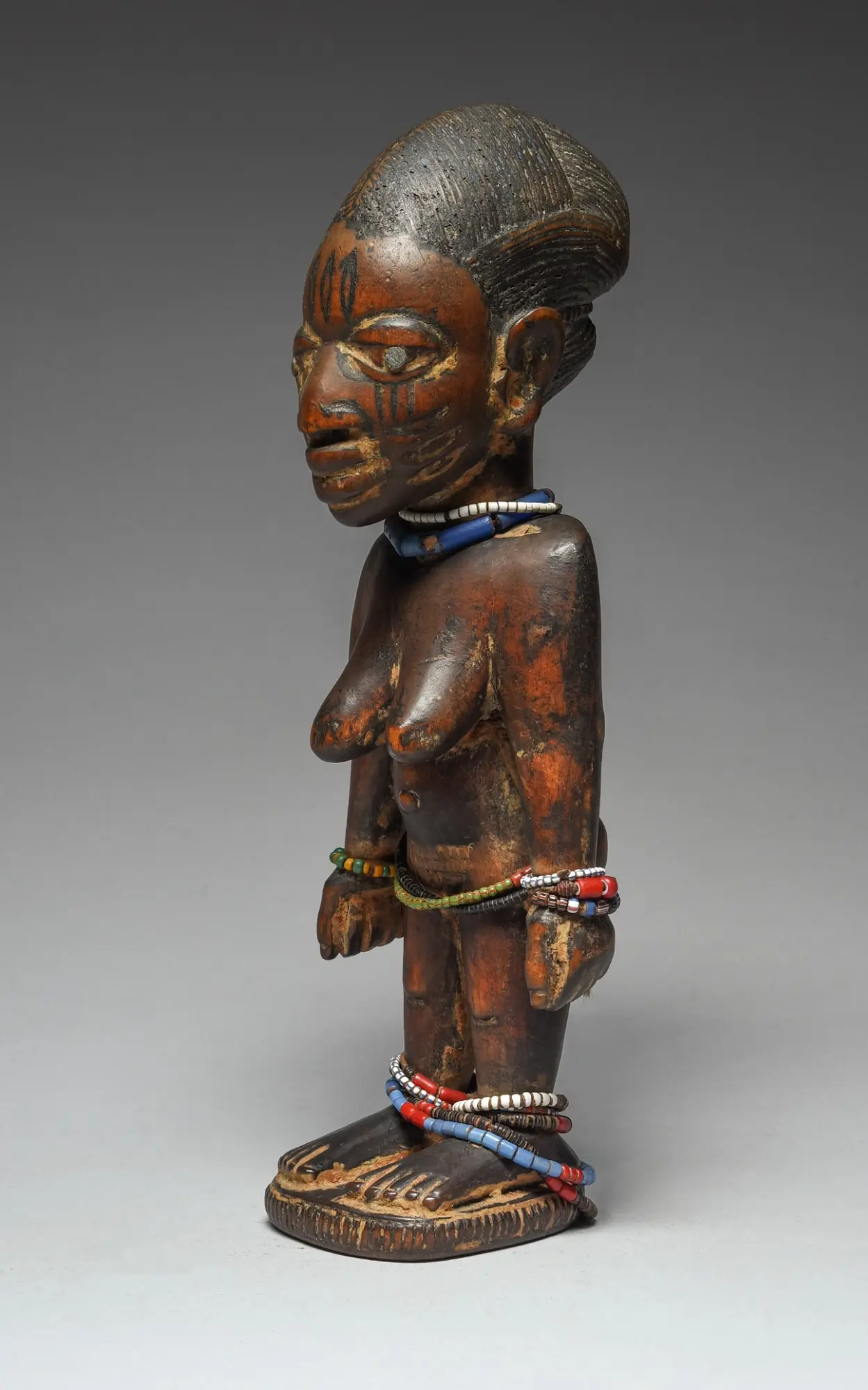
Repeated gestures can alter wood more profoundly than any single ceremony. Camwood and oil warm the body; washing softens exposed planes; indigo or laundry blue may settle into a coiffure; handling rounds projections. These traces deserve attention, but none should be treated as a mechanical certificate of age.

01

Washing and rubbing

Liquids, oils and pigments accumulate unevenly according to the areas reached by hands and cloth.

02

Feeding and offerings

Food and libations acknowledged the figure's place in the family and could leave deposits in crevices.

03

Carrying and dressing

Textiles, cords and close bodily contact could reshape a surface through friction and pressure.

04

Beads

Glass, shell and other beadwork marked care, wealth, exchange and identity; additions may belong to different moments.

05

Metal

Iron, copper alloys and metal-set eyes can evoke protection, power and associations with Ògún.

06

Tirah

Leather amulets containing written or protective matter reveal the interaction of Yoruba practice with Islamic culture.

Adorned female Ere Ibeji with layered bead ornaments

Beyond the central figure

Names, relatives and transitions

Idowu

The child born after twins holds a defined position within Yoruba naming sequences. Small figures described as Idowu should be examined carefully: their identification depends on context and cannot be inferred from scale alone.

Changing religious lives

Conversion, migration, the death of a custodian or the loss of ritual knowledge could bring active care to an end. In some accounts, divination and offerings prepared the transfer or release associated with a figure. In others, objects simply remained in the household, entered a shrine, or moved gradually into the art market.

Desacralization

There is no reason to assume one standardized procedure for every community. What matters is recognizing that leaving ritual use could itself be a significant transition—not merely the moment an object was sold.

How to look

A clue is not a conclusion

Deep wear, dark patina, old beads or ritual deposits can be persuasive. They become meaningful only when they agree with the carving, wood, construction, collection history and the natural pattern of use. The strongest reading combines evidence instead of letting one dramatic feature dominate.

See the selection criteria