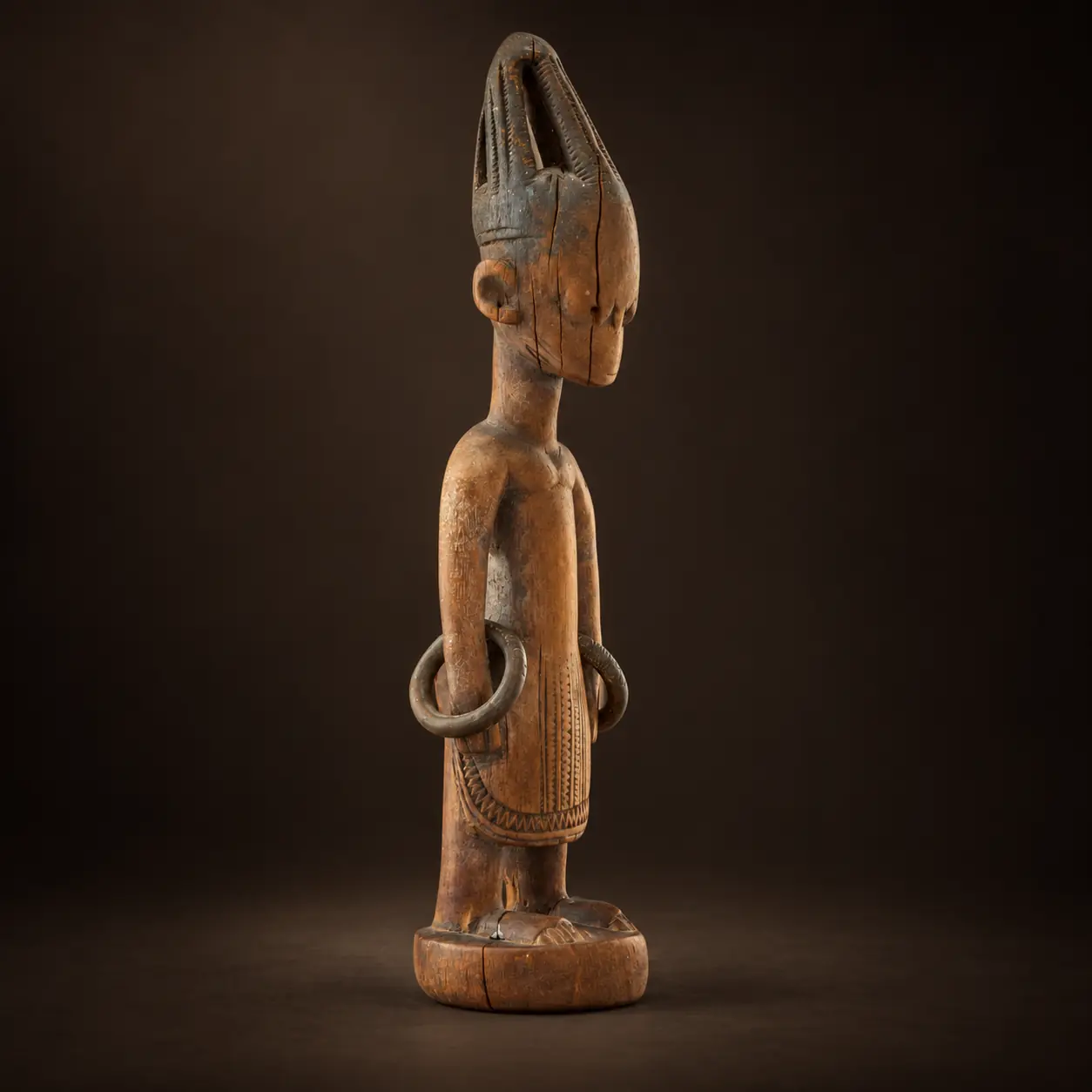
OyoThe former Oyo sphere contains some of the broadest variation in Ere Ibeji. Oyo City, Ibadan, Shaki, Kishi and neighbouring centres developed distinct workshop languages under a shared courtly and political horizon. Upright balance, carefully organized coiffures and composed faces recur, but the category is too large to function as a single style.
Kwara StateNorthern Yoruba production around Ilorin, Egbe and related centres sits at a cultural crossroads. Some figures approach Oyo or Igbomina conventions; others show local solutions and ornaments shaped by an environment in which Islam, trade and Yoruba ritual coexisted. Tirah amulets can be part of this history, but do not prove an Ilorin origin by themselves.
IgbominaIgbomina country includes major carving centres and unusually varied bodies of Ere Ibeji. Ila-Orangun, Omu-Aran and surrounding towns produced recognizable workshops rather than one uniform canon. Refined coiffures, controlled stance and strong facial architecture appear in many examples, yet attribution depends on precise workshop comparison.
EkitiEkiti sculpture is marked by powerful workshop identities and important named lineages. Bold heads, assertive facial modelling and carefully structured bodies can appear, but “Ekiti ears” or another isolated feature are not enough. The region's dense network of carvers requires close comparison with documented corpora.
AbeokutaFounded as a major Egba centre, Abeokuta gathered populations, cults and artists in a rapidly developing urban setting. Houses such as Eshubiyi–Akinyode and Adugbologe–Makinde demonstrate how workshop continuity can produce related Ere Ibeji while preserving differences between individual carvers and generations.
Egba–EgbadoThe wider Egba and Egbado field cannot be collapsed into the history of Abeokuta alone. Local workshops across southwestern Yorubaland developed compact, forceful or highly individualized solutions. Political displacement and mobility complicate any attempt to draw a clean stylistic boundary.
IjebuIjebu centres produced sculpture with its own sense of proportion, facial order and surface detail. The region's commercial networks encouraged movement toward Lagos and the coast, while artists such as Thomas Ona Odulate show how local tradition could meet new patrons and subjects.
AworiAwori communities around the Lagos and Ota regions occupied a zone of circulation rather than isolation. Their Ere Ibeji must be distinguished carefully from neighbouring Egba, Egbado and Ijebu works. Urban growth and the movement of objects make provenance particularly valuable.
Anago–KetuAcross the Nigeria–Benin border, Anago and Ketu traditions belong to a connected Yoruba cultural landscape shaped by frontier history and exchange. Figures may combine traits familiar from western Yorubaland with locally specific proportions, scarification and ritual treatment.
Yagba–EgbeAt the northeastern edge of the Yoruba world, Yagba and Egbe production forms another transitional field. Works can approach northern Yoruba and Kwara State conventions while retaining distinctive workshop habits. The label is best used comparatively and with attention to collection history.