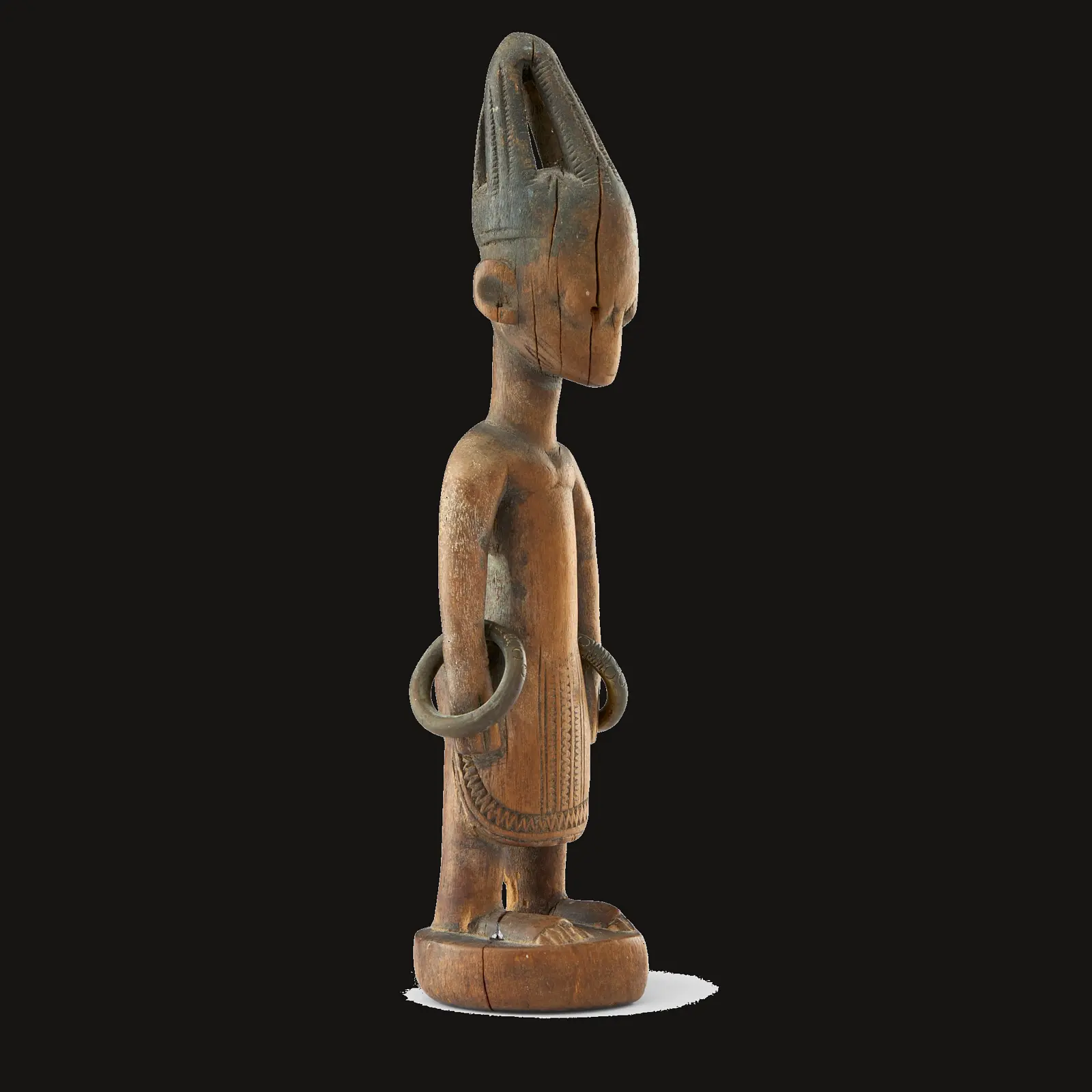
01Ọlọ́wẹ̀ of Ìsẹ̀
Known above all for audacious palace and shrine commissions, Ọlọ́wẹ̀ transformed established conventions through projecting forms, movement and dramatic spatial relationships.
02Moshood Bámigbóyè
Carver, teacher, healer and civic figure of the Odo-Owa region, remembered particularly for monumental Epa masks and a far-reaching workshop influence.
03Areogun line
Dada Arowogun and George Bamidele Areogun connect long workshop transmission with new religious, educational and institutional commissions.
04Abeokuta houses
The Eshubiyi–Akinyode and Adugbologe–Makinde houses demonstrate how recognizable forms could persist while individual members introduced subtle changes.
05Thomas Ona Odulate
An inventive figure working between Ijebu traditions, Lagos audiences and the emerging colonial market, with a distinctive, often immediately legible manner.
06Fakeye family
A multi-generational Igbomina carving lineage whose continuity helps reveal how knowledge, motifs and professional identity travel through a family.
Ọlọ́wẹ̀ of Ìsẹ̀A court artist of exceptional ambition whose doors, veranda posts and shrine works pushed Yoruba carving toward projection, asymmetry and movement. His reputation provides a crucial reference point for understanding individual authorship in a tradition often presented anonymously.
Moshood Olúṣọmọ BámigbóyèActive around Odo-Owa and Kajola, he combined carving with roles as healer, leader and teacher. His monumental Epa masks are central to his legacy, while attributed Ere Ibeji extend the view of his sculptural vocabulary into a more intimate format.
Dada ArowogunA major Ekiti-region carver associated with the Areogun lineage. His workshop language travelled across doors, posts, masks and religious commissions, demonstrating how a strong hand could remain legible across very different functions.
Bamgbose of OsiAn Osi carver connected with the dense artistic environment of northeastern Yorubaland. Works linked to his circle help place Ere Ibeji beside broader shrine and architectural production rather than treating them as an isolated genre.
George Bamidele AreogunTrained within the Areogun tradition and active during a period of expanding institutional patronage. His career crossed Yoruba religious commissions, Ogboni contexts, Christian projects and the teaching networks that shaped modern recognition of named carvers.
Agbonbiofe of Efon-AlayeA key name in the complex sculptural landscape of Efon-Alaye. Attributions depend on comparing facial construction, stance and workshop habits across several object types, not on assigning every local figure to one celebrated hand.
Obembe of Efon-AlayeAlso known through the title Chief Ologunde, Obembe belongs to the history of Efon carving lineages. The surviving record invites caution because names, titles and workshop relationships are not always documented consistently.
Thomas Ona OdulateAn inventive early twentieth-century artist working between Ijebu, Lagos and an expanding clientele. His figures often translate contemporary people and occupations into a compact, recognizable personal idiom; rare twin figures attributed to him remain especially significant.
Eshubiyi–Akinyode houseAn Abeokuta workshop history in which family transmission matters as much as a single name. Related works show continuity in pose and facial architecture while also revealing variation between generations and individual hands.
Adugbologe–Makinde workshopA powerful Abeokuta lineage linked to Oniyide, Adugbologe and Makinde. Repeated compositional habits allow works to be compared as a workshop corpus, although the precise division between participating carvers remains a matter for careful attribution.
Duga of Meko and GaniyuA compound-based tradition associated with Meko and with production extending beyond Ere Ibeji to other Yoruba sculptural forms. The relationship between Duga and his son Ganiyu illustrates how family continuity can preserve a model while gradually transforming it.
Fakeye familyA celebrated Igbomina dynasty whose history leads from local carving practice to nationally and internationally visible careers. Its genealogy makes the family particularly valuable for studying apprenticeship, inheritance and stylistic change.
Abogunde of EdeA carver and workshop identity associated with Ede. The corpus encourages comparison between inherited regional conventions and the stable anatomical decisions through which a workshop becomes recognizable.